As promised, we’re going to talk about speech exceptions this week.
Although the First Amendment guarantees broad protection from government interference with speech, the Supreme Court has recognized limited exceptions to that protection. In other words, free speech isn’t absolute.
The First Amendment protects a lot of ugly speech, including the offensive, uncomfortable, and deeply unpopular. But not all speech is protected. There are rare circumstances where the government is allowed to step in and punish speech without violating the Constitution.
Those exceptions include incitement to violence, true threats, and fighting words.
The exceptions are very narrowly tailored, specific, and focused on immediate harm, not purely offense. When courts evaluate whether speech may be punished, they consider context, intent, and imminence.
Incitement to Violence
The Supreme Court didn’t always get incitement to violence right. Over time, it experimented with different legal tests, some of which were more restrictive of speech than others.
Initially, the Supreme Court applied the bad tendency test. Under this approach, speech could be punished if it had a tendency to lead to harm, even if no harm actually resulted. This standard is dangerously vague and functioned as a “what if” standard. It allowed the government to punish speech based on speculation rather than concrete facts. People could be punished for what someone feared their words might do, not what their words actually did. This approach risked chilling speech by discouraging people from speaking out at all.
The Court later established the clear and present danger test, which required a closer connection between the speech and potential harm. Under this standard, speech could be restricted if it posed a real and imminent threat that a serious substantive harm would result. In practice, the clear and present danger test still gave the government too much room to punish speech, which is why the Court eventually replaced it with a more protective standard.
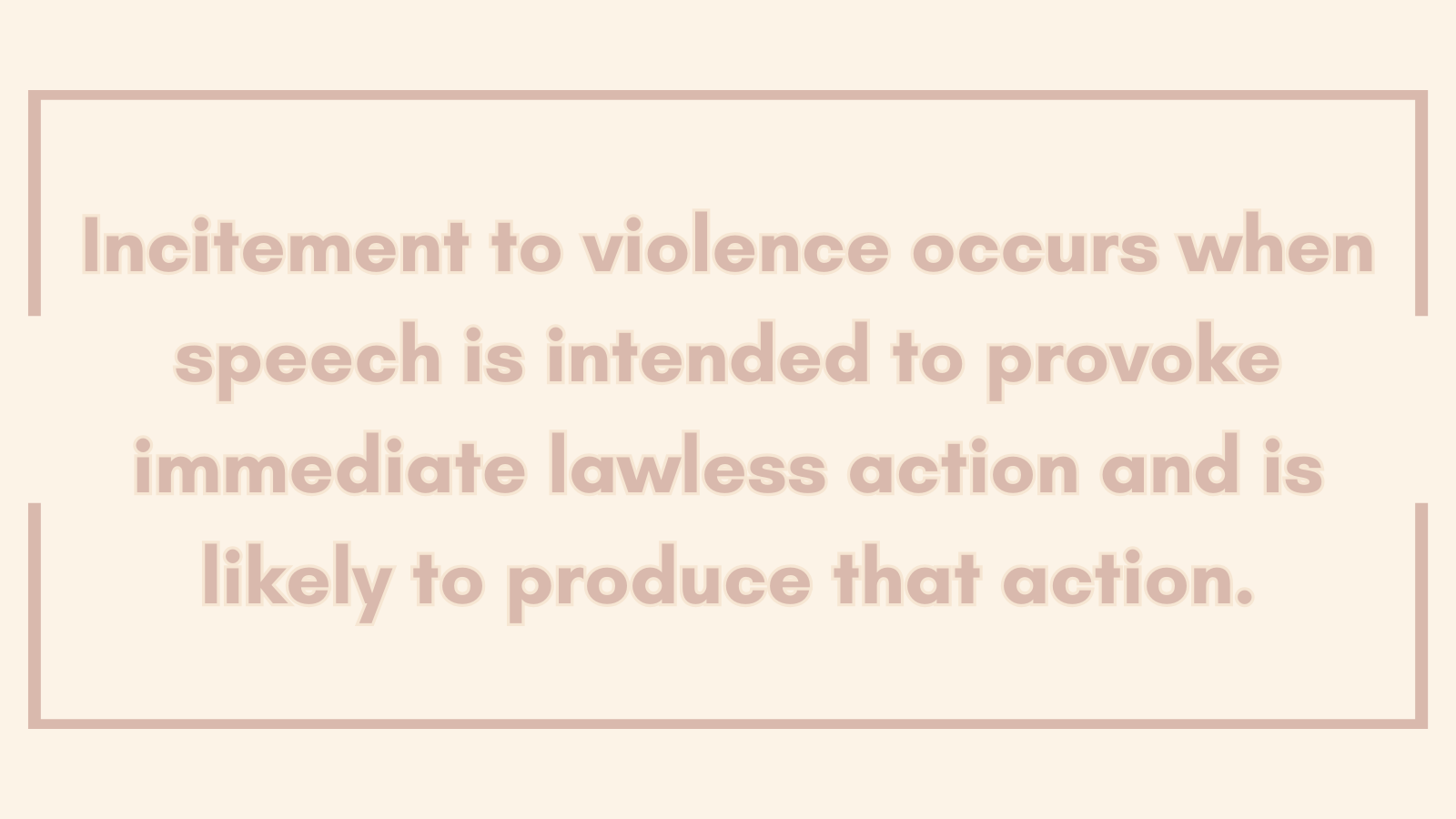
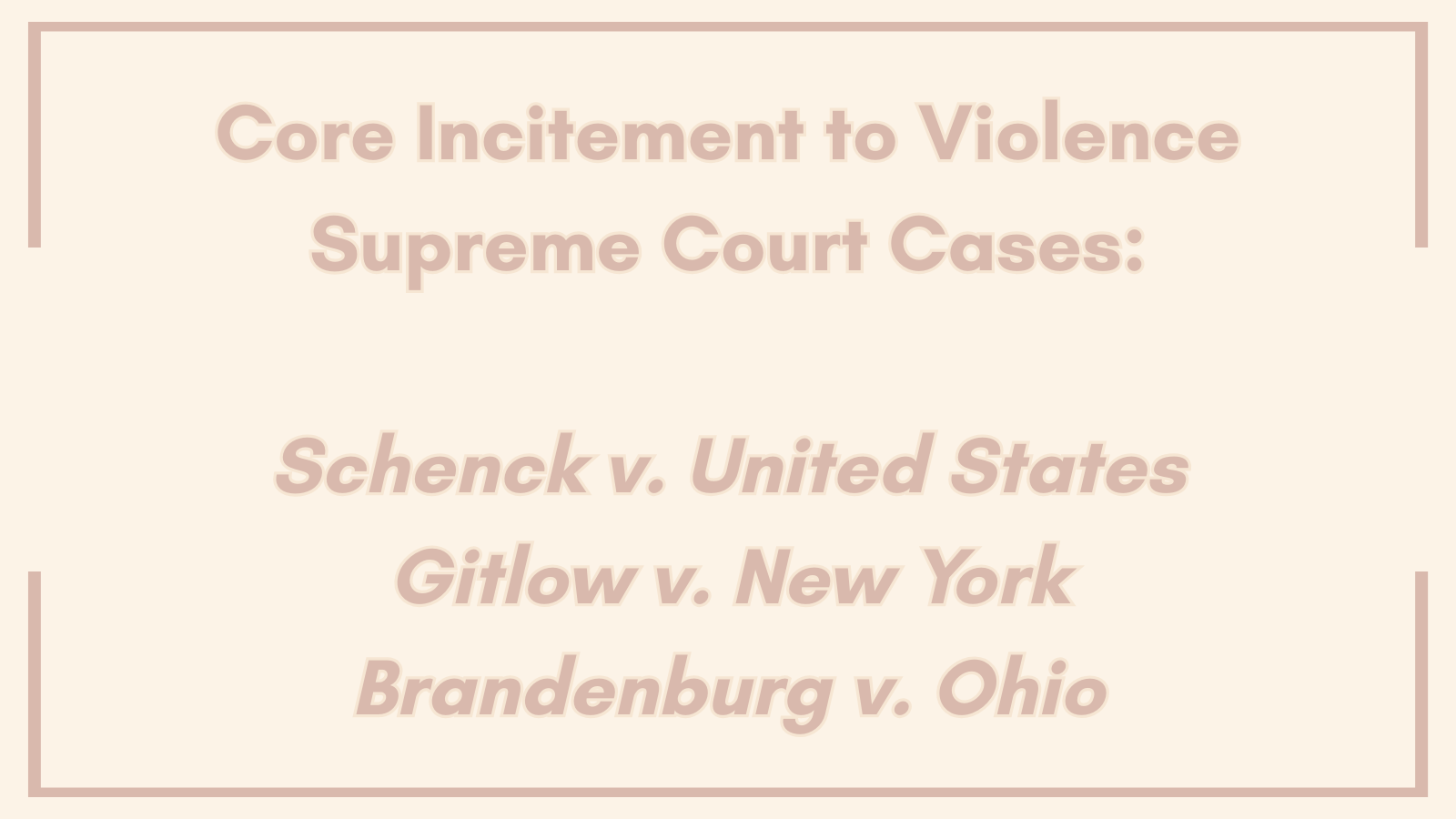
Today, the governing standard is the Brandenburg test, established in Brandenburg v. Ohio. This test distinguishes between advocating for ideas and inciting immediate violence.
Both elements of the Brandenburg test must be met in order for the government to punish speech under incitement to violence:
The speech was directed toward inciting or producing imminent lawless action and is
Likely to produce such action.
Timing and likelihood are critical factors. Abstract statements, political rhetoric, or general calls for action are still protected unless the speech is intended to trigger immediate lawbreaking and has a real chance of doing so.
In short, the First Amendment protects the right to advocate, but not the right to incite.
True Threats
Another category of unprotected speech is true threats. True threats focus less on provoking others to commit an act of violence and more on causing fear of violence directed at a specific individual or group.
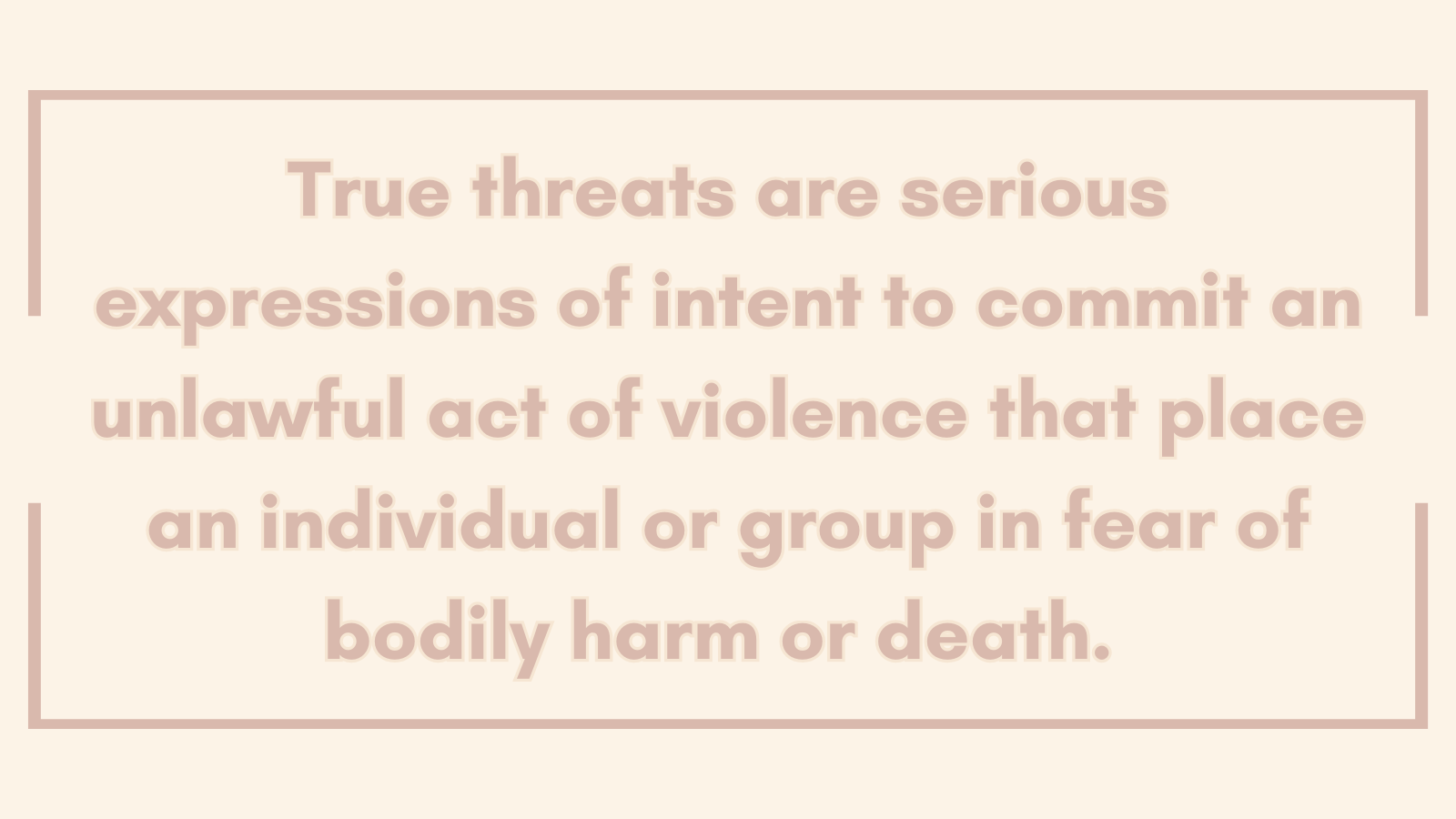
In Virginia v. Black, the Court made clear that true threats involve more than just offensive or symbolic expression. The key concern is intent to intimidate — speech meant to place someone in fear of bodily harm or death.
The question of intent expanded in Elonis v. United States. In this case, the Court rejected the argument that a speaker could be punished simply because their words caused fear. Instead, the government must prove that there was subjective intent, meaning the speaker had to intend the threatening nature of the speech, not simply say something that frightened another person.
Most recently, in Counterman v. Colorado, the Court expanded on this standard to include recklessness. In other words, a speaker must consciously disregard a substantial risk that their words would be perceived as threatening. Negligence isn’t enough.
Taken together, these cases show how narrowly true threats are defined. For speech to qualify as a true threat, courts use the following test:
The speaker directs the message to an individual or group,
Acts with intent or at least recklessness, and
Knows a reasonable recipient will perceive a threat
Being offended isn’t the same as being threatened. That distinction is the core of the Supreme Court’s true threats doctrine.
Fighting Words
The final speech exception is fighting words. Fighting words are defined as words that “by their very utterance, inflict injury or tend to incite an immediate breach of the peace.” The use of this standard is fairly limited.
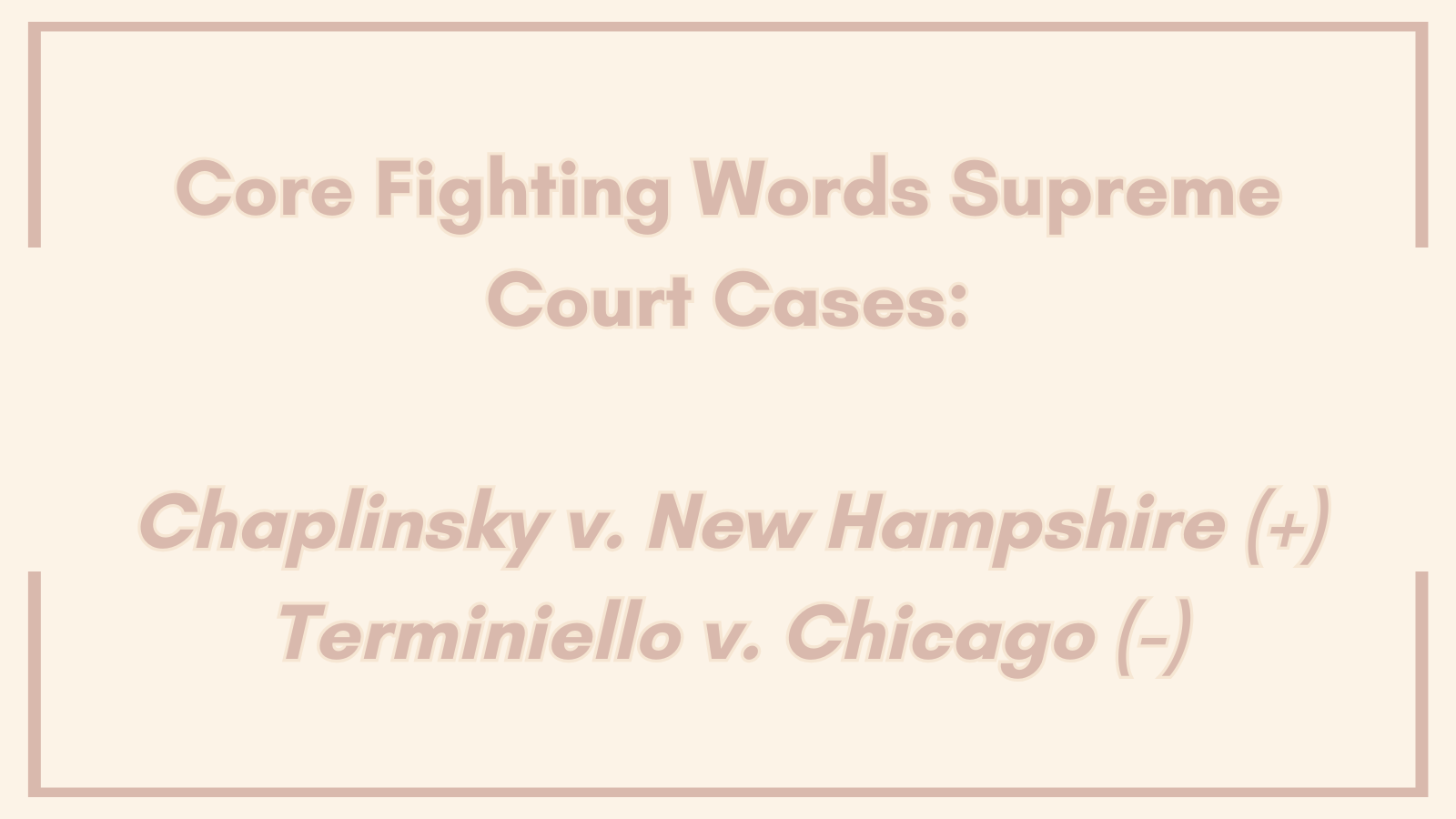
The fighting words doctrine comes from Chaplinsky v. New Hampshire, a Supreme Court case from 1942. Under Chaplinsky, fighting words are direct, face-to-face personal insults addressed to an individual and inherently likely to provoke immediate violence.
In theory, fighting words are not protected by the First Amendment. In practice, the courts almost never rely on this standard today.
That’s because the category is extremely narrow. General insults, offensive speech, and even highly inflammatory language typically do not qualify as fighting words. As a result, modern courts are hesitant to use the exception at all.
The Supreme Court’s skepticism toward fighting words is reflected in later cases like Terminiello v. Chicago. The Court held that speech could be restricted only in the event that it was “likely to produce a clear and present danger of a serious substantive evil that rises far above public inconvenience, annoyance, or unrest.” In other words, the government cannot punish speech simply because it angers, offends, or upsets listeners. Writing for the Court, Justice Douglas wrote that “a function of free speech under our system is to invite dispute. It may indeed best serve its high purpose when it induces a condition of unrest, creates dissatisfaction with conditions as they are, or even stirs people to anger.”
The First Amendment does not exist to protect only polite or agreeable speech. It protects speech that provokes, challenges, and unsettles, as long as it does not cross the line into immediate violence.