

Imagine you’re a licensed therapist. A teenager sits down across from you and says they want to talk about their sexual orientation. You listen and respond, but provide no medication or procedure. You just have a conversation.
Now imagine the state makes that conversation illegal.
That’s not a hypothetical. It’s the question sitting before the Supreme Court right now, and the answer could redefine the limits of the First Amendment for every licensed professional in America.
It’s just words
Sexual orientation change efforts — commonly called SOCE, or conversion therapy — refer to counseling practices that aim to change a person’s sexual orientation or gender identity. Major medical organizations have said it is ineffective and potentially harmful. Proponents argue that individuals have the right to pursue therapy aligned with their values and beliefs.
But this post isn’t about whether conversion therapy works, or whether it should. It’s about something much more narrow and fundamental to the constitution: when the government bans a type of conversation, does that violate the First Amendment?
States and municipalities across the country have passed laws prohibiting licensed therapists from practicing SOCE on minors. When those bans got challenged in court, the First Amendment became the battleground.
The Eleventh Circuit draws a line
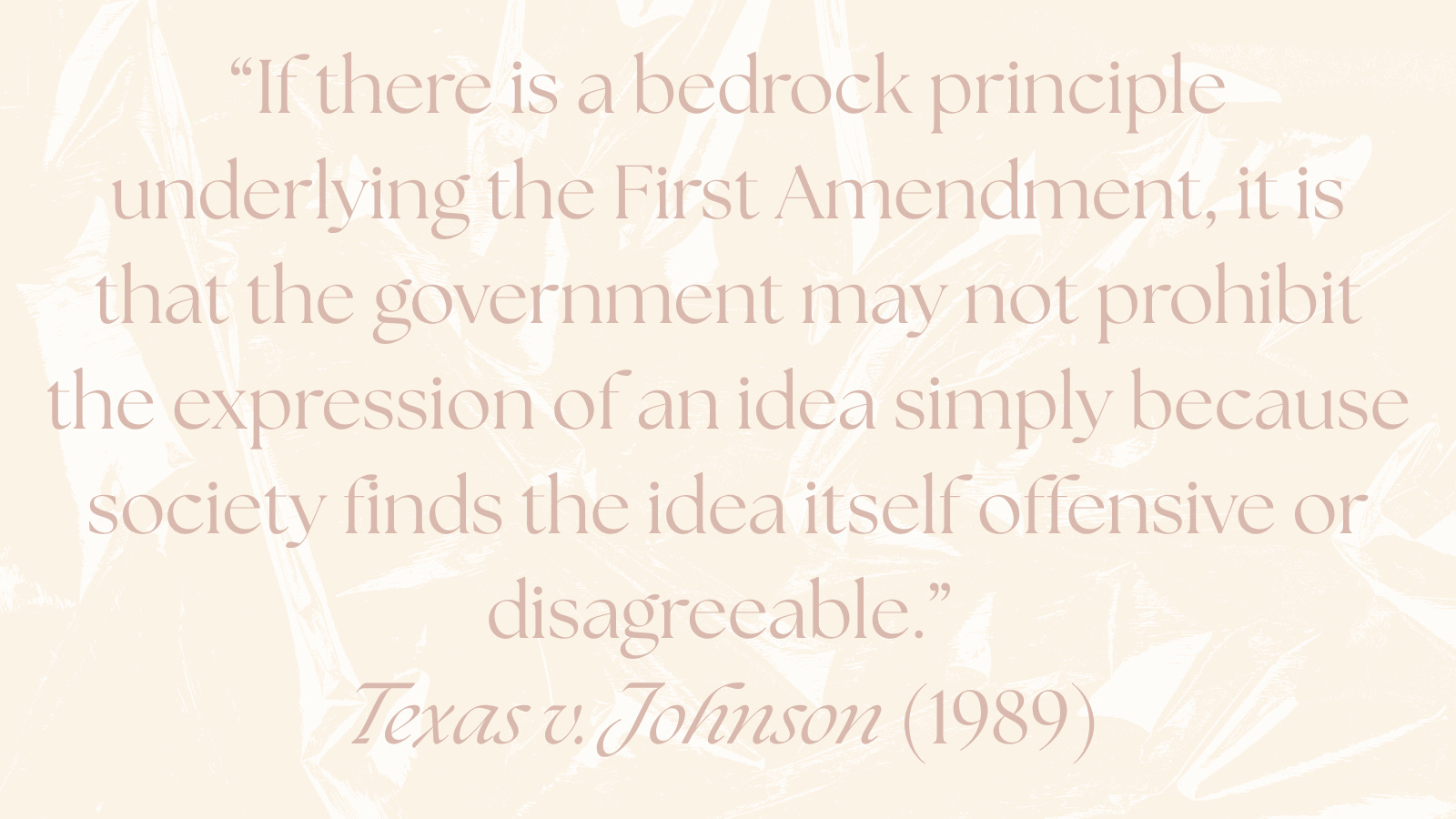
In Otto v. City of Boca Raton (2020), the Eleventh Circuit faced that question head-on. Two Florida therapists argued that local ordinances banning SOCE for minors violated their First Amendment rights because their therapy consisted entirely of speech. The city called it a medical procedure. Judge Grant wasn’t convinced. In her opinion, she wrote “If SOCE is conduct, the same could be said of teaching or protesting — both are activities, after all. Debating? Also an activity. Book clubs? Same answer.”
Because the ordinances restricted speech based on its content — and favored one message over another — the court applied strict scrutiny. The government had to prove the law served a compelling interest and was narrowly tailored to achieve it. It couldn’t pass that test, and the bans were struck down.
A license isn’t a loophole
Boca Raton’s argument — that regulating licensed professionals is different from regulating speech — wasn’t new. The Supreme Court had already addressed it in NIFLA v. Becerra (2018).
California had passed a law requiring licensed pregnancy crisis centers to inform clients about state-funded reproductive services. The centers argued it violated their First Amendment rights by forcing them to deliver a government message. The Supreme Court agreed.
Justice Thomas, writing for the majority, rejected the idea that “professional speech” is a lesser category of First Amendment protection. The government can’t avoid strict scrutiny simply by targeting what a licensed professional says.
In other words, a therapist’s words don’t lose constitutional protection just because they happen in a clinical setting.
That principle is exactly what the Eleventh Circuit relied on in Otto, and exactly what the Supreme Court is now being asked to apply in Colorado.
The Supreme Court to weigh in
Which brings us to Chiles v. Salazar — and the Supreme Court.
Kaley Chiles is a licensed counselor in Colorado challenging the state’s ban on SOCE for minors. Her argument will feel familiar by now: her therapy is conducted entirely through speech, the ban targets her message specifically, and under NIFLA, it should trigger strict scrutiny. Colorado’s counter will also feel familiar: it’s a professional regulation protecting minors from harm, not a restriction on speech.
The Supreme Court heard oral arguments on October 7, 2025. And within the first hour, Justice Kagan cut to the heart of it.
She posed a hypothetical: what if a minor says “I’m gay and I want to be more comfortable with it” versus “I’m gay and I want to change it”? Under Colorado’s statute, one of those conversations is legal, but the other isn’t. To know which is which, she pointed out, you have to examine the content of what’s being said, and evaluate whether the message meets the state’s approval. That sounds a lot like viewpoint discrimination.
Colorado’s attorney pushed back, arguing the law regulates a harmful medical treatment, not a point of view.
The Court hasn’t decided yet. But whatever they hold will set the standard for every state with a SOCE ban on the books, and potentially far beyond.
Why it matters
At its core, this case asks how much power the government has to regulate speech simply by routing that regulation through a professional license. If the Court holds that states can ban certain conversations in a licensed setting, the door protecting professional speech won’t just be cracked open — it will be kicked down entirely.
The First Amendment has always been most valuable when it protects speech that somebody, somewhere finds harmful. That’s not a defense of conversion therapy. It’s a reminder that the legal principles the Court applies here will outlast this case by decades.